This post may contain affiliate links. If you purchase through these links, I may earn a small commission at no extra cost to you. Thanks for supporting my site! See our privacy policy for more information.
About Death Valley
Death Valley is one of the hottest places in the United States, not just among national parks, but anywhere in the country. In summer, temperatures regularly soar past 115°F. Yet this desert is also a land of opposites. When rain does fall, the cracked earth blooms into wildflowers. Winter can dust the Panamint Range with snow while the basin below sits hundreds of feet beneath sea level.
I visited Death Valley National Park as the very first stop on a two-week National Park road trip. Starting here set the tone for the trip in the best way. The landscapes shocked me, shimmering salt flats, jagged salt spires that look otherworldly, hidden waterfalls tucked into canyons, and soft golden dunes.
This is not a one-day park. Because the sights are spread out and many of the accommodations are outside the park boundaries, you need at least three days to cover the highlights without feeling rushed. Honestly, you could easily spend a week here and still discover new corners while exploring Death Valley National Park.


National Park Musts
Before we jump in, a quick PSA:
- Download offline maps—service is spotty at best.
- Tell someone your plans and check in after your hike.
- Carry more water than you think you’ll need (trust me).
- Pack salty + protein snacks.
- Always stay on the trail to protect the landscape.
- Absolutely no smoking in or near the park.
FYI: Death Valley is quite remote. There is nearly no cell phone service in the park and any help may be hours away. Please be prepared with plenty of water, food and a spare tire. It is recommended to bring 2 spare tires if you are traveling on any of the backroads.

How to Get to Death Valley
Death Valley straddles the California–Nevada border. While most of the park is in California, the easiest access is from Nevada.
The most logical airport is Las Vegas (LAS), about a two-hour drive to the park depending on which entrance you use.
- While there are a number of unpaved roads entering the park, these are the paved roads used to access Death Valley.
| Paved Access Road | Distance from Airport | Nearby Point of Interest |
| SR 374 from Beatty, NV | ~ 2 hours from Las Vegas | Stovepipe Wells |
| CA 178 from Shoshone, CA | ~ 1. 5 hours from Las Vegas | Badwater Basin |
| SR 267 from US 95, NV | ~ 3 hours from Las Vegas | Ubehebe Crater |
| -CA 190 from Olancha, CA & Death Valley Junction, CA -SR 136 from Lone Pine, CASR 178 Panamint Valley Rd. from Trona, CA | ~ 3 hours from Bakersfield airport | Panamint Springs |


Where to Stay in Death Valley
Accommodations inside the park are limited and can be pricey during peak season. Staying within the park cuts down on driving time, but nearby towns can also make great bases.
Otherwise here is a breakdown of access time from a couple nearby towns.
- Beatty, Nevada: about 45 minutes from Furnace Creek.
- Parumph, Nevada: about 1.5 hours from Furnace Creek.
- Lone Pine, California: about 1 hour 45 minutes from Furnace Creek.
In Park Lodging
- About $180/night
- This hotel has both hotel accommodations and full RV hookups for those traveling that route. They have two onsite restaurants, a little shop and even a pool to cool off after a hot day of hiking. Located in the Stovepipe Wells area, the in park accommodations are a great jumping off point for exploring the park. Fuel is available here.
- About $450-$550/night.
- This gorgeous hotel is located near Furnace Creek and provides luxury accommodations while staying in Death Valley. They have a number of dining options, pool, spa and golf course. A perfect place to relax after a day of hiking in the desert.
- About $200/night.
- This hotel is located just down the road from its sister hotel The Inn at Death Valley. Full of amenities the Ranch has a pool, tennis courts, golf course and spa. Furthermore, this is a great spot for families as they have small casitas and cottages to accommodate groups. Finally, there are onsite campgrounds you can book as well.
- $15-$300/night depending on accommodations.
- Panamint Springs Resort is a great stop with a multitude of options for accommodations and price ranges. They have camping sites, tents, glamping tents, dry RV spots, RV spots with hookups, hotel rooms, cabins and even bunk rooms. Located conveniently near Panamint Springs, this is a great option if you are approaching the park from the west. Fuel is available here.
Camping in Death Valley
Death Valley has both developed and primitive campgrounds. Conditions vary widely, so always check closures on the NPS site before heading out.
- Furnace Creek Campgrounds: Only site with reservations, though limited in summer.
- Texas Springs: Each site has a picnic table and fire grate.
- Sunset Campground: Large, open campground; no fires allowed.
- Wildrose Campground: At 4,100 feet in the Panamint Mountains, prone to strong winds.
- Mesquite Spring Campground: At 1,800 feet, near Scotty’s Castle Road, with fire grates and picnic tables.
Primitive Campgrounds (all require high-clearance vehicles; some 4×4 only):
- Thorndike: forested, 7,400 feet.
- Mahogany Flat: forest views at 8,300 feet.
- Eureka Dunes: at the base of giant sand dunes.
- Homestake: rugged, remote.
- Saline Valley: famous for its hot spring, but tough to reach.

Staying Outside the Park
Beatty, Nevada (45 minutes to Furnace Creek) is my personal favorite. Wild donkeys roam the streets, there’s a small but fun local bar, and it makes a charming home base. I stayed in a cozy cabin from Airbnb here, which made mornings and evenings extra memorable.
Other options:
- Pahrump, NV – About 1.5 hours away.
- Lone Pine, CA – Roughly 1 hour 45 minutes away, great if you’re also planning a Mount Whitney or Alabama Hills detour.
Park Access
Don’t forget that entry to the park for 4 people/1 car is $30. If you plan on visiting more than 1 day or multiple national parks during the year you must opt for the year long pass. It has paid dividends for me time and time again. The American the Beautiful pass is $80, lasts for an entire year and has unlimited park access. Grab yours here.
Ready to Explore? Book Here ↓
Things to do
Artists Palette
It is nearly impossible to choose one place I loved the most in Death Valley National Park, but the Artists Palette was definitely near the top. You can explore this area via the 9 mile Artists Drive Scenic Loop. You’ll see how volcanic deposits have created a multitude of colors across the landscape. Make sure to hop out of the car and explore around the hills, when you’re done you’ll enjoy the remaining drive through the gorgeous loop.
Ubehebe Crater
Located in the northern part of the park, you can see this crater. Known as a Maar volcano, the crater was created when lava came in contact with ground water, which created steam and enough pressure to blow through the earth above. This is the largest of the craters in this crater field and is a sight to behold.
Badwater Basin
This is the lowest point in continental North America at 282 feet below sea level. It is a stark difference in view compared to the rest of the beige and gold colored park. Home to the former Lake Manly, over the years its slowly accumulated sediment and salt and the lake eventually ceased to exist in that form. Today we can now see and traipse over the concentrated salt deposits.
Wildrose Charcoal Kilns
Ten beehive-shaped kilns built in the 1870s to produce charcoal for silver mining. They’re remarkably well-preserved and make for an eerie, photogenic stop.
Devils Golfcourse
This surreal landscape was named for its craggy, sharp salt spires that take up the entire space. Because “only the Devil can play golf here”. Another monument to the diversity of Death Valley National Park, this unique type of salt is incredible to see up close and personal. While there isn’t much to do here and it is certainly difficult to walk along, it is absolutely worth stopping by.

Viewpoints
Mesquite Flat Sand Dunes
Golden dunes right next to the road. Hike out far enough to leave the crowds behind, then watch the sunset paint the sand in soft oranges and pinks. Cartwheels optional but encouraged.
Dantes View
Rising up to 5,575 feet this is an opportune spot to watch the sunrise or the sunset and is a popular stop for photographers. Sitting above Badwater Basin and along the ridge of the Black Mountains, it’s truly a spectacular sight.
Zabriskie Point
Named for Christian Zabriskie, a prominent person of the Pacific Coast Borax Company (lol), this is a popular spot to enjoy the incredible views. From this viewpoint you will see the striped hills and badlands below.
Father Crowley Vista Point
Named after a priest who often stopped to admire the views between his home of Lone Pine and Death Valley, he was known as the Desert Padre.
Stargazing
Death Valley National Park has been dubbed part of the International Dark Sky Park. On a moonless night, the Milky Way blazes across the sky. Bring a red flashlight to preserve your night vision.

Hikes
There are a number of great hikes throughout the park and some for all levels. There are also hikes that have no exact marked path and are trail-less so to speak. Feel free to adventure to those, but with caution and a compass.
- 1 mile and 86 feet of gain.
- This is a quick hike with negligible gain. On this short hike you’ll see a rock formed natural bridge and just beyond is a dry waterfall.
- 7 miles and 450 feet of gain.
- This is by far and away the best hike in Death Valley National Park. A rocky trail turns foresty (yes a word) and a bit wild as you continue along this relatively flat path. You’ll see sneak peaks of water and algae along the way before you end at a small oasis and waterfall. A stark difference from the desert around you, this water feature and rocky waterfall feels like you have been transported to Neverland.


- This trail gives you a choice of your own adventure. You can complete one portion of the hike or combine them to make it longer.
- Badlands loop: 2.7 miles and 535 feet. This starts at Zabriskie Point and loops through the badlands.
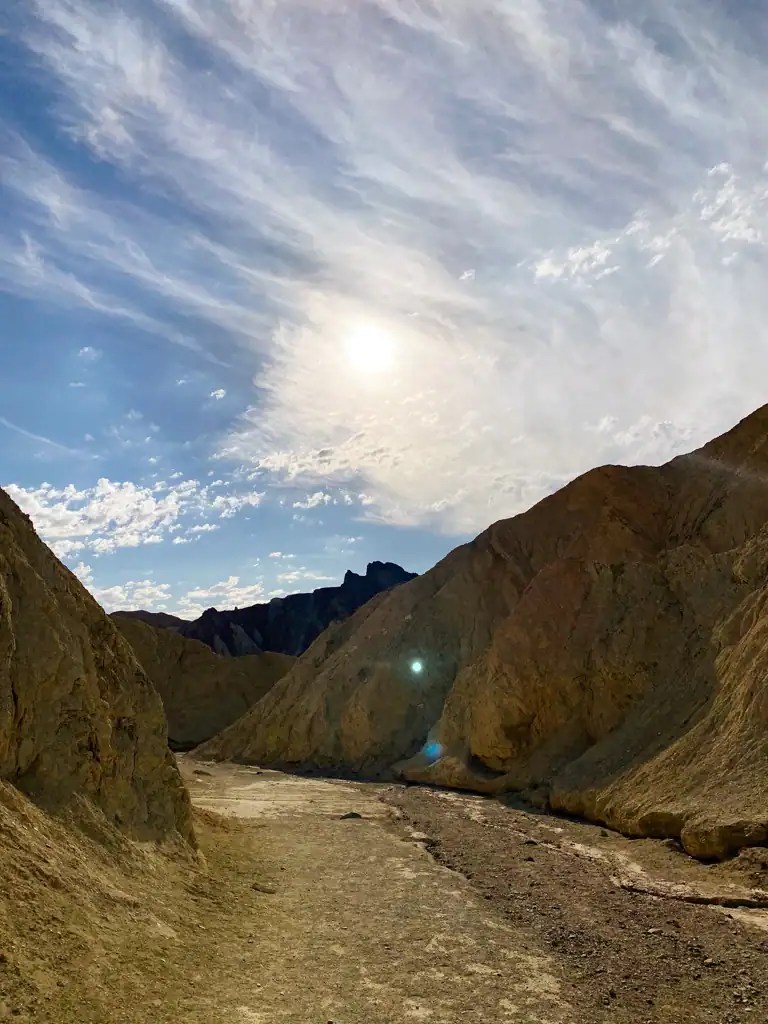
- *Golden Canyon to Red Cathedral: 3 miles and 577 feet of gain. this was my favorite hike of the three. The Red Cathedral is a truly jaw dropping end point to this hike between golden walls and up rocky corridors.
- Gower Gulch Loop: 4.3 miles and 850 feet of gain. As you make your way through narrow canyons, you’ll have the opportunity to do a little rock scrambling before eventually finding the gulch.
- 4 miles and 1,200 feet of gain
- To complete this hike you’ll pass through 3 narrow canyons, climb over a giant boulder jam to find your trail and end at a rock amphitheater. Keep an eye out for the mosaic rocks that give the canyon its name.
- 8.4 miles, 2200 feet of gain.
- This hike starts at the Wildrose Charcoal Kilns (two for one!) and ends on a peak overlooking Death Valley. The hiking trail winds through a forest before the switchbacks take you up the peak.
Hikes with Unmarked Routes
- Desolation Canyon
- Willow Canyon
- Panamint Dunes
- Little Bridge Canyon
- Sidewinder Canyon
- Fall Canyon
- Corkscrew Peak
- Telescope Peak


Backpacking
Backpacking here is for the bold. Trails are often unmarked, water is scarce, and the solitude is profound. Here is a list of all the backpacking options you can explore. FYI: most of these require high clearance vehicles and some 4×4 capable.
- Bighorn Gorge
- Cottonwood-Marble Canyon Loop: permit required
- Fall Canyon
- Red Empitheatre
- Hungry Bill’s Ranch
- Indian Pass
- Owlshead Mountains
- Panamint Dunes
- Surprise Canyon
- Telescope Peak
- Titanothere Canyon
Final Tip
After a long day of heat, dust, and rock scrambling, reward yourself with a stop at The Inn at Death Valley. Sit in the cool, shaded lobby and order a prickly pear margarita. It might be the best cocktail you’ll ever have, equal parts refreshing and life-changing after a desert hike.

The Bottom Line
Death Valley is a park of extremes, contradictions, and unforgettable experiences. From the lowest basin to snow-capped peaks, from fiery sunsets to star-filled nights, it’s a place that challenges you and rewards you in equal measure.
Spend at least three days here if you can. You’ll leave dusty, tired, and completely awed by the beauty of this desert.
Pin this post for your next trip! ↓