
This post may contain affiliate links. If you purchase through these links, I may earn a small commission at no extra cost to you. Thanks for supporting my site! See our privacy policy for more information.
There’s something you need to know about me: I love tourist sights. I like to visit the thing in the place, in fact, its kind of the point, no? I’m a sucker for a good tour, I’ll happily wait in line, I’ll book my tickets in advance, I’ll even put on a funny headset.
I learned the value of tours and guides and knowing what you’re experiencing when I compared my first visit to the Vatican museum to my second one (more on that below). But, I decided on my 3rd trip to Rome, I was going all out. I’d already checked off the big ones, St. Peter’s Basilica, the Spanish Steps, but this time I wanted to dig deeper. Enter: the Vatican Keymaster Tour.

How it Works
The idea is simple but genius: a small group joins the man with the keys as he opens the Vatican Museum before sunrise, unlocking doors and turning on lights room by room. Normally this process takes four hours every morning and evening, but for two hours you get to “help.” When I heard about it, I knew I had to go. Yes, I’d already visited the Vatican twice before, but this felt special. Spoiler: it was.
Color me devastated when I found it to be fully booked for every day I was in Rome, even looking a few months in advance. After weeks of obsessively refreshing two different booking sites, the travel gods (and maybe Pope Leo’s blessing) smiled on me. I snagged a spot for my final morning in Rome.


The Early Start
This tour is not for late risers. You need to be outside the Vatican Museum by 5:50 a.m. And if you’re like me, overexcited and worried about oversleeping, you show up at 5:20, standing there with about 19 other strangers wondering why you’re awake at such an ungodly hour. The Vatican Museum opens promptly at 8:00 am so this tour runs before the massive crowds arrive.
Two guides lead the way:
- The Keymaster: one of the Vatican staff who handles unlocking duties. He let us turn keys, flip switches and accepts that everyone is taking pictures of everything and gives us time to make sure our shots were just right.
- The Tour Guide: ours was an art historian trained in restoration and preservation. She added context, translated when needed, and sprinkled in details that made the halls come alive. She also was an excellent photographer and hype woman.

The Tour
I have spent a lot of time in the Louvre in the past year (3 separate visits) and it just makes me really appreciate the Vatican Museum. While the Louvre is humongous and houses a ton of incredible art. The Vatican Museum is palatable and doable, has great art, impressive frescos and is steeped in religious and Italian history. You can leave the museum after only a couple hours feeling like you saw nearly everything.
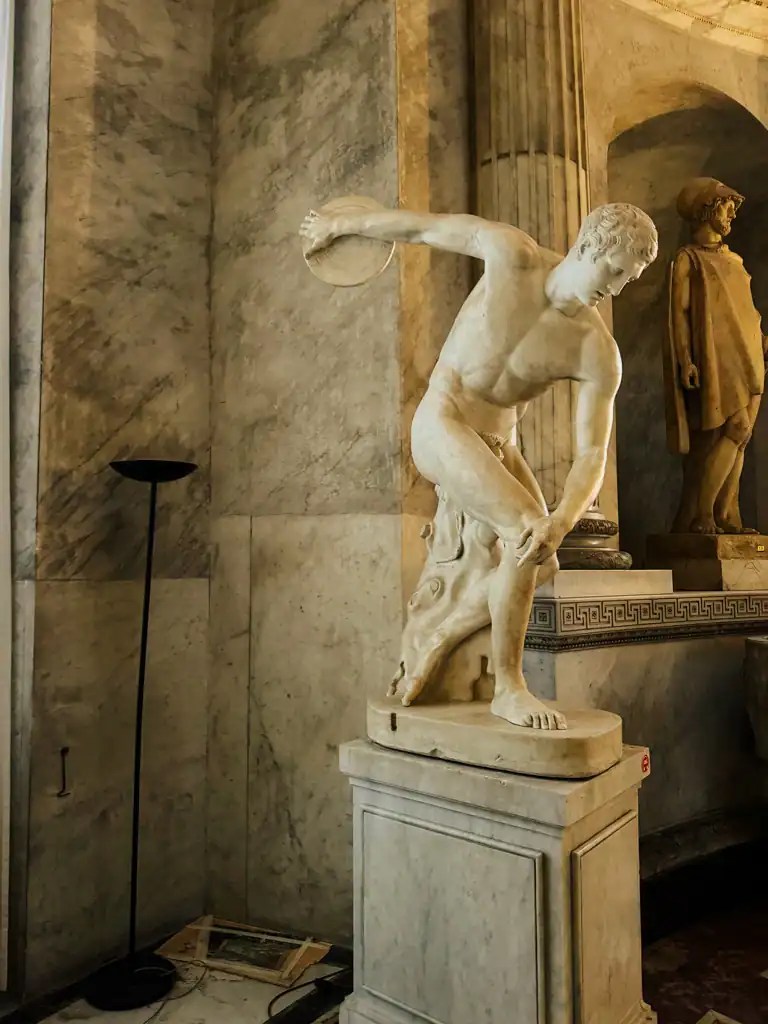
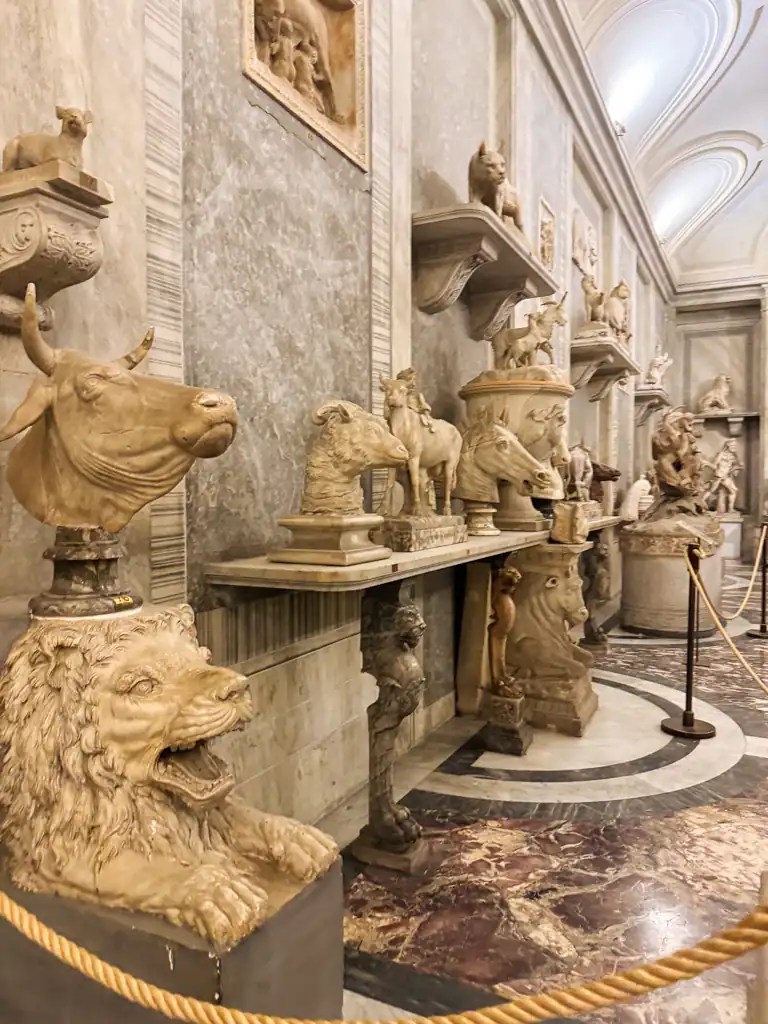


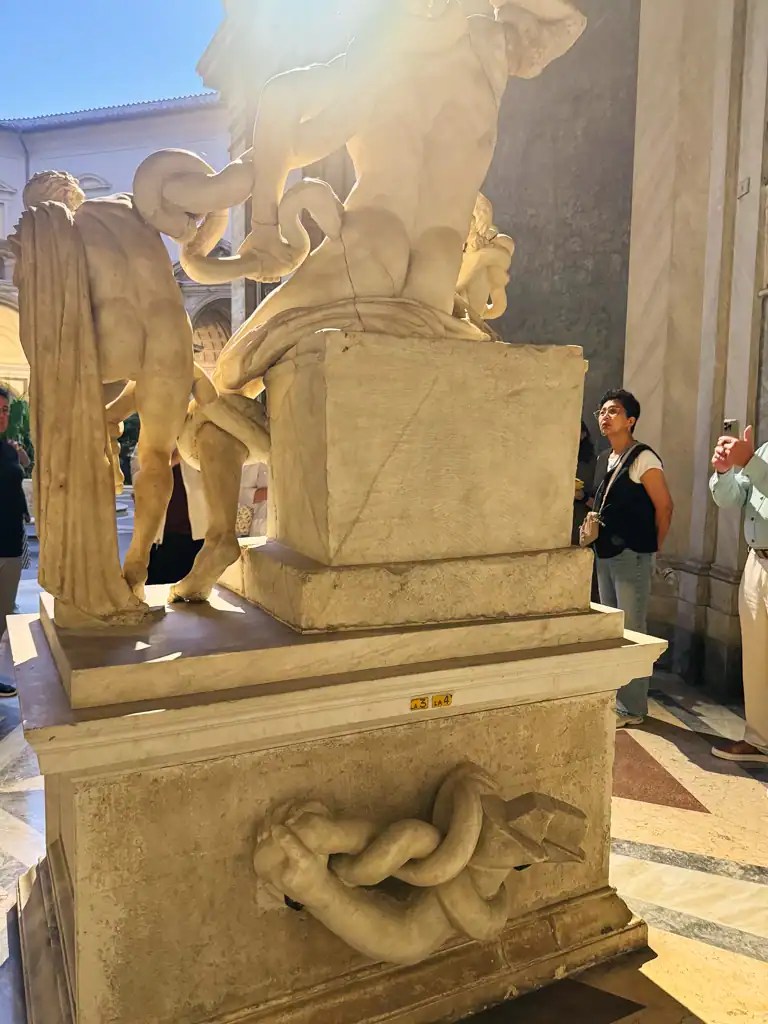

Typically you aren’t allowed access to the backside of Laocoön and His Sons, but the Keymaster Tour provides some extra privileges.
Unlocking History
We began at the rotunda with its famous spiral staircase. I snuck my way to the front (worth it) and coincidentally got to open the first door. The keys don’t even slide in very far, you twist and suddenly a centuries-old door creaks open. We stepped onto a terrace with St. Peter’s Basilica glowing in the dark.
From there, the tour followed the usual Vatican path, but with the magic of being alone.
- The Sarcophagus of St. Helena: made of rare red porphyry marble, once reserved only for emperors. St. Helena was the mother of Constantine the Great, and this massive coffin was her resting place.
- The Rotunda Room: modeled after the Pantheon by Michelangelo himself, complete with a dome and oculus. In the center is a bathtub-sized basin carved from a single piece of marble, valued at more than €2 billion.
- The Courtyard of the Belvedere: usually shoulder-to-shoulder with tour groups, but here it was utterly quiet. The statue of Laocoön and His Sons is the star: a dramatic scene from the Trojan War where serpents sent by Athena and Poseidon strangle the priest Laocoön and his sons for opposing the Wooden Horse. Fun fact: when the statue was discovered in 1506, Laocoön’s arm was missing. For centuries, artists debated whether it was raised in struggle or bent. In 1905, the missing arm turned up in an antiques shop, bent at the elbow, proving Michelangelo’s guess had been right all along. It wasn’t reattached until 1958.
Icky Things from Ancient Rome
- The Athlete: this statue was excavated in Trastevere, in the cellar that’s now part of the restaurant Spirito di Vino (which still has great food, by the way). The figure is caught mid-action, scraping sweat and grime off his body with a strigil. Here’s where it gets gross: athletes used to save that sweat, hair, and oil in bowls and sell it to women, who applied it as skincare. Yes, ancient athlete sweat as moisturizer. History is wild and kind of gross.
Now that your done gagging over that last bit of history, we breezed past the Egyptian Rooms (sarcophagi, relics, even some mummies) before entering the Gallery of the Candelabra. Among the marble statues, my favorite detail was Faun with Infant Dionysus, one of the few statues with painted eyes. Most ancient statues are blank stone, so seeing color feels uncanny.


The Lights-On Moment
One of the absolute highlights was the Gallery of Maps. We waited in the dark while our guide flipped the switch, and suddenly the hallway glowed: intricate frescoes covering the vaulted ceiling, giant maps of Italy lining the walls, golden details catching the light. Through open windows, we caught glimpses of sunrise over the Vatican gardens and St. Peter’s dome.
Next were the Raphael Rooms. The first time I came here at 21, I barely looked, just rushed to the Sistine Chapel. On my second visit, I learned more context as we followed Rick Steve’s Vatican Tour playing in our ears while we learned the significance of these rooms. On this visit, I really appreciated them. Raphael’s School of Athens is iconic, featuring Plato, Aristotle, and other great thinkers. But the coolest detail? A self-portrait of Raphael himself, tucked shyly on the right.
PS: If you like context and history, I can’t recommend Rick Steve’s Audio Europe app enough. Very specific tours for a number of destination.


The Sistine Chapel
At last, the grand finale: the Sistine Chapel. Unlocking this door felt surreal. Each night, the key is sealed in an envelope signed by two guards, so breaking that seal in the early morning was a real privilege. A couple who was celebrating their 30th wedding anniversary had the opportunity to unseal the envelope and together, unlocked this iconic door.

No matter how many times I’ve seen it, the Sistine Chapel takes my breath away. Michelangelo painted the ceiling alone, at just 33 years old, covering it with scenes from Genesis, the Creation of Adam, the Fall of Man, and more. Decades later, at 66, he returned to paint The Last Judgment, a monumental fresco of heaven, earth, and hell. The sheer scale and detail are overwhelming.
We lingered here longer than anywhere else, marveling in silence. Every guest was given the chance to unlock the chapel doors. It was a staged close the door, unlock, enter, be wowed! Of course I took my opportunity to do the same. Standing in the same space where cardinals gather to elect a new Pope? Unreal.
A note about pictures. This was definitely a guided tour for those who want photos and videos. The guide and keymaster made it abundantly apparent where the good photo ops were and let us stay in each place until we had all exhausted our photo options. The keymaster kindly “turned his head” while in the Sistine Chapel, which is notorious for not allowing photos or videos. I plead the 5th 🙂
Ready to Explore? Book Here ↓
The Bottom Line
By 8 a.m., we were back at the gift shop as other groups began trickling in. I grabbed a cappuccino and croissant in the Pinecone Courtyard café (and reluctantly returned my husband’s phone, which I’d stolen for the better camera). The sun was shining brightly now, with St. Peter’s in the background it was a stark difference in where we started to now. As I walked to grab in uber through the crowds, lines and guides with flags I felt so grateful to have the opportunity to take the Vatican Keymaster Tour.
Was it worth it? Without question. This tour is for you if:
- You don’t mind a tour that isn’t terribly in depth.
- You crave a crowd-free Vatican.
- You’re okay with a brutal alarm clock.
- You don’t mind spending extra for a once-in-a-lifetime experience.

Technically, you can re-enter afterward and do the whole museum again to see what you did’t see in depth or stroll slowly through the rooms of artifacts. But honestly, nothing compares to wandering it in silence, flipping on the lights as you go.
If you want to book, try:
This was hands-down one of my favorite travel experiences ever. And if you made it through my nerdy history tangents, thanks for indulging me.
If you need help deciding where to stay in Rome check out my guide to the best Roman neighborhoods or explore the next destination on your Italy itinerary with my favorite Tuscan towns!
Pin this post for your next trip! ↓